
Press Release
Major Victory for Maryland Voters as Language Access Bill Signed into Law
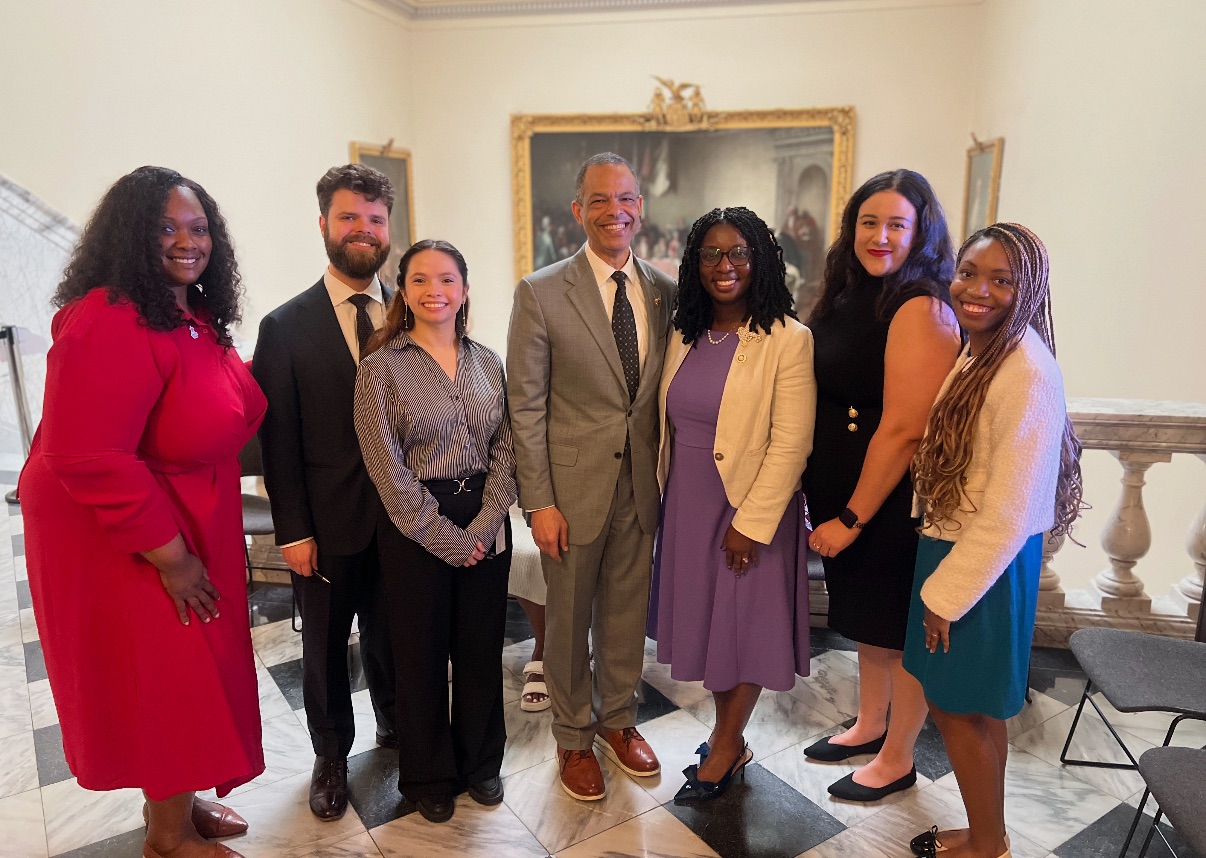
Annapolis – Today, Gov. Wes Moore (D-Maryland) signed into law legislation that will help ensure voters with limited English proficiency have the tools they need to meaningfully participate in elections. SB685/HB983 was part of the Maryland Voting Rights Act package championed by the Maryland Voting Rights Act Coalition.
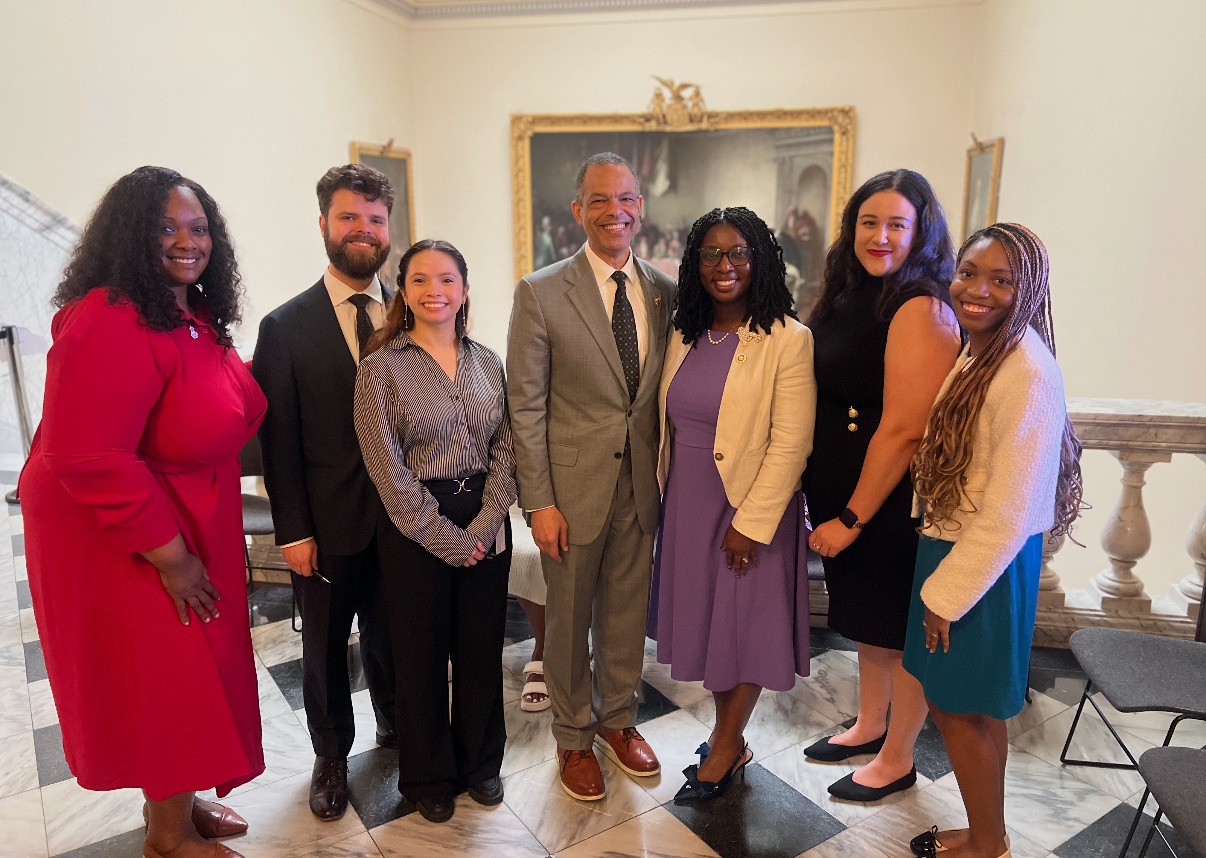
Pictured from left to right: Common Cause Maryland Executive Director Joanne Antoine; chiefs of staff for Sen. Augustine and Del. Mireku-North; Senate President Pro Tem Malcom Augustine; Del. Bernice Mireku-North; League of Women Voters Maryland Executive Director Nikki Tyree; and Common Cause Maryland Policy & Engagement Manager Morgan Drayton at the bill signing.
“Growing up in a mixed household where Haitian Creole was spoken, I saw firsthand how not speaking a certain language can limit your participation in society,” said Joanne Antoine, Executive Director of Common Cause Maryland. “Changes to the election process and complicated ballot questions can be hard to understand even for English speakers, so it’s imperative accurate translations are available. This legislation will ensure every Maryland voter, no matter which language they speak, can engage in our democratic process.”
“As we enter an era of increasing uncertainty on the continuation of federal voting rights protections, Maryland needs its own standards to protect access to voting,” said bill sponsor Delegate Bernice Mireku-North (D14-Montgomery County). “Continuing to rely solely on the federal framework ignores Maryland’s growing language minority communities, who will benefit from the increased language-related assistance and materials provided in the bill. This includes Maryland’s sizable French, Amharic, and Arabic-speaking communities. This bill will also benefit Maryland’s growing Hispanic communities by expanding Spanish language assistance. As Maryland communities continue to diversify, House Bill 983 is a necessary continuation of the effort to ensure all voters, regardless of language proficiency, have access to the ballot.”
“SB 685 responds directly to the needs of the growing population of Marylanders with limited English proficiency. All Marylanders, regardless of English proficiency, must have access to the ballot. Translating election materials under S.B. 685 is crucial to full political participation of all Marylanders,” said bill sponsor Senate President Pro Tem Malcom Augustine (D47-Prince George’s County).
Maryland is the most diverse state on the East Coast, and one in five Marylanders speak a language other than English at home. While Maryland has worked hard to strengthen voting accessibility, voters only benefit if the options for voting and the overall process are in a language they can understand.
“Maryland joins a growing number of states that are leading the way to a more inclusive, accountable government by ensuring all Marylanders are able to make their voices heard without discriminatory language barriers,” said Lata Nott, director of voting rights policy at Campaign Legal Center. “This final piece of legislation safeguards the right of Maryland voters who do not primarily speak English to participate in the democratic process. We applaud the signing of this commonsense legislation and are encouraged to see states continue to make strides toward a more inclusive future.”
SB 685/HB983 will provide more access for limited English proficient (LEP) voters by:
- Lowering the threshold for providing translations to language communities where there are at least 4,000 citizens of voting age, or the community makes up at least 2% of the county’s citizens of voting age;
- Ensuring election materials are translated to languages meeting the threshold and that they are reviewed for accuracy;
- Requiring translated signage approved by the State Board of Election at polling places;
- Providing secure technology that allows for nonpartisan oral and visual translations at polling places for LEP voters who may also need assistance reading and all voters, including those who speak English, who may need assistance in ASL.
For more information about this legislation, click here.
###