Пресс-релиз
2019 is the Year We Slay Gerrymandering
Raleigh, North Carolina — Leading activists, academics and attorneys in the national redistricting reform movement will convene in North Carolina today and Saturday to plot the demise of gerrymandering in 2019.
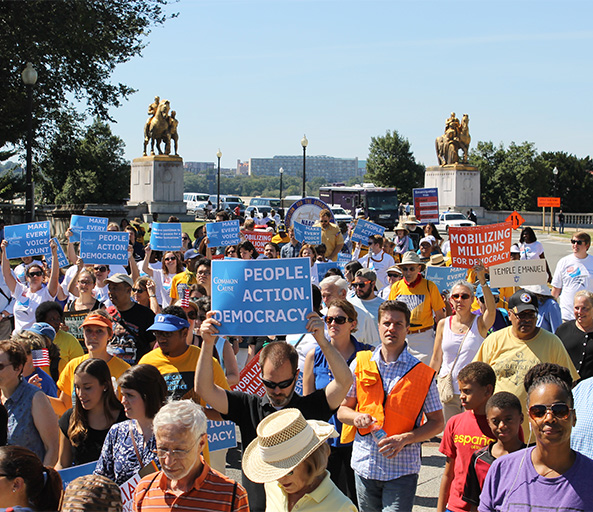
The reformers at the third annual Конференция по вопросам разума, реформы и перераспределения избирательных округов convened by Common Cause are taking an all-in approach – fighting for fair maps in citizen-led ballot initiatives, pushing state legislation and taking two high-profile cases to the U.S. Supreme Court in March — to ensure every vote counts and every voice is heard.
Their goal is to have a new, clear national standard against partisan gerrymandering and clear pathways for states to draw congressional and legislative boundaries that are fair, impartial and responsive to people rather than politicians. Time is of the essence as states will use the 2020 Census to draw voting maps that will impact who is elected and represented for the decade to come.
“This is the year that redistricting as we know it must change. Elections should be decided by voters, not the politicians drawing maps. We’ve won at the ballot box, we’ve won in the courts, and momentum is in our favor as we head to the Supreme Court,” said Катай Feng, national director for redistricting at Common Cause and architect of the California Citizens Redistricting Commission, the gold standard in state-based, independent redistricting commissions.
The conference comes about nine weeks before the Supreme Court is expected to hear oral arguments in two partisan gerrymandering cases, Ручо v. Common Cause and Lamone v. Benisek. In each case, partisan legislators – Republicans in North Carolina and Democrats in Maryland – stated in public that they drew congressional district lines to disadvantage minority party voters and to maximize the majority party’s power.
Common Cause argues that this partisan gerrymandering punishes supporters of the minority party based on their political beliefs and violates the First Amendment. A growing consensus of legal experts agree that these cases provide the single best opportunity for the U.S. Supreme Court to declare partisan gerrymandering unconstitutional.
Several of the key players in the litigation will explain their strategies and path to victory during the conference including Эммет Бондюран, Michael Kimberly и Allison Riggs. Here is their take on the cases and what they mean for the country:
«Ручо v. Общее дело is the perfect test case for partisan gerrymandering,” said Bondurant, the lead litigator for the Common Cause plaintiffs in Ручо v. Общее дело. “North Carolina Republican state legislators stated on the record on what they intended to do, precisely how they intended to do it and then did it.”
“The Court has been hesitant to wade into the issue of partisan gerrymandering, but there’s no way the legislative branches will solve this problem because it’s the fox in charge of the hen house,” said Kimberly, lead litigator in Ламоне против Бенишека. “The Court essentially has two choices: agree that partisan gerrymandering violates the First Amendment, or endorse a practice that openly targets citizens on the basis of their political views, which I don’t think they will be willing to do.”
“Voters in North Carolina haven’t had a fair election in a decade. The Supreme Court has the chance to restore a voice to millions of voters here and nationwide,” said Riggs, litigator in Ручо v. League of Women Voters of North Carolina, which is consolidated with Ручо v. Общее дело.
The third annual Reason, Reform & Redistricting conference is convened by Common Cause, a nonpartisan grassroots organization, in collaboration with Duke University’s Center for Political Leadership, Innovation, and Service (POLIS) and the Sanford School of Public Policy. It features 14 panels covering issues including racial equity, quantitative metrics, First Amendment arguments against gerrymandering and lessons learned from reform victories in the states.
Conference participants include Kareem Crayton of the Southern Coalition for Social Justice; David Daley of FairVote; Katie Fahey of Voters Not Politicians; Curtis Hubbard of Fair Maps Colorado; Justin Levitt of Loyola Law School; Celina Stewart of League of Women Voters; Arturo Vargas of NALEO; Сэм Ван of the Princeton Gerrymandering Project.
View the conference agenda здесь and tune into Facebook Live dispatches здесь.