
Blog Post
April Fair Democracy Huddle – Links and Resources
Blog Post
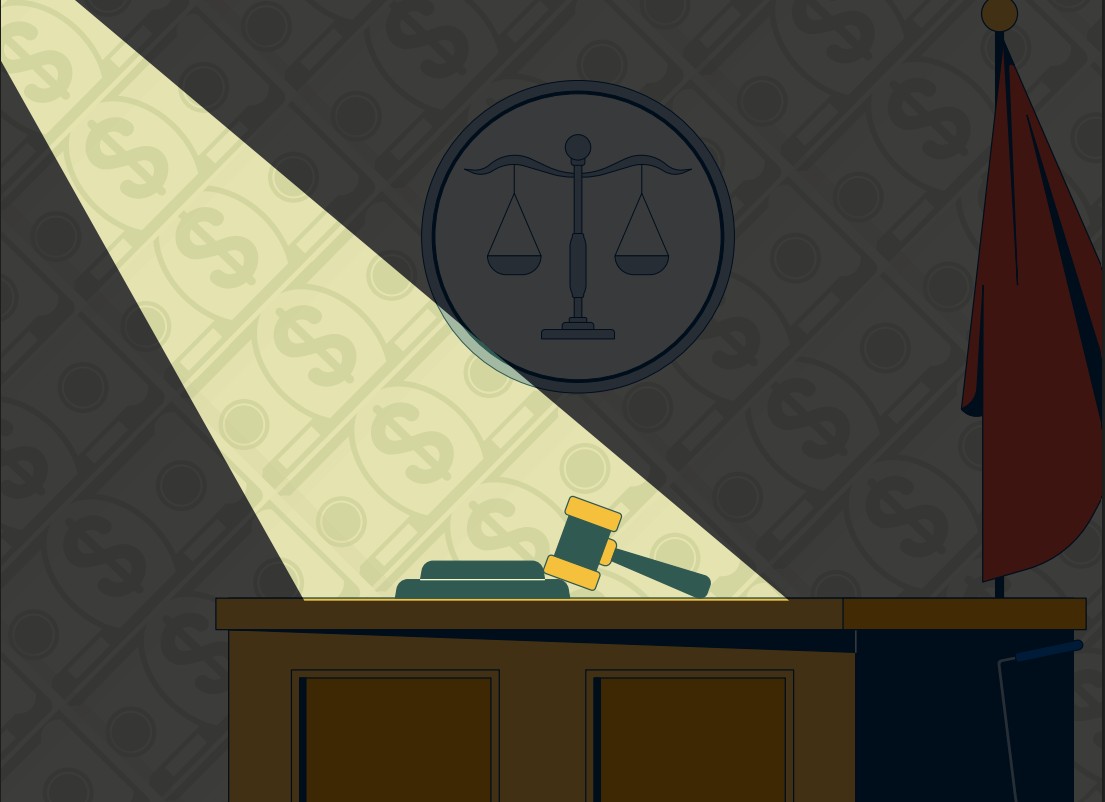
Common Cause Ohio and the Ohio Fair Courts Alliance released Buying the Bench: Uncovering Dark Money Donors in the 2024 Race for Ohio Supreme Court.
This report examines how groups unaffiliated with any candidate spent nearly $6 million on political advertising in 2024. But that number doesn’t provide a complete picture. This report examines the broader and more difficult questions: Who is trying to influence Ohio voters—and why? It also seeks to demonstrate how successfully dark money activities are kept secret, and how difficult it is—even for the most experienced researchers—to figure out who is behind political ads, including those in judicial campaigns.
Transparency in campaign finance allows voters to consider the source behind political messages.
It raises the essential questions:
When voters know who is spending money to influence their decisions, they can make more informed choices. Transparency fosters accountability and helps guard against corruption. Yet in recent years, uncovering this information has become increasingly difficult.
It was not always this hard. In the past, voters and journalists could trace political money through public filings with the Secretary of State or the Federal Election Commission. That changed with the 2010 U.S. Supreme Court’s Citizens United v. FEC decision, which dismantled key campaign finance laws and opened the floodgates to secret, unlimited spending by corporations and billionaire-backed political nonprofit organizations.
Citizens United ushered in the era of “dark money”—political spending by groups that are not required to disclose their donors. These groups often include 501(c)(4) nonprofit organizations or 527 political organizations that obscure where their money comes from and what their funders want.
Even though Super PACs are legally required to disclose their donors to the Federal Elections Commission, they can receive money from dark money groups, effectively hiding the true source of their funding. These opaque financial structures make it extraordinarily difficult to “follow the money.” In addition, right-wing donors are increasingly using donor-advised funds (DAFs)—like DonorsTrust or Schwab Charitable—as pass-throughs to obscure funding sources even further.
Dark money is a threat to our judicial system. It is not just a problem in legislative or presidential races—it is reshaping judicial elections, including those for state supreme courts. When wealthy individuals and interest groups spend millions to influence who sits on the bench with no real transparency, judicial independence is at risk.
Many of those spending money on ads in judicial races have economic interests that may come before the court. Although 2009’s Caperton v. A.T. Massey Coal Co. determined judges shouldn’t hear the cases of those who substantially supported their campaigns (including major donors to political advertisements), the public is unlikely to be able to track these political dollars. And in Ohio, judges are not required to recuse themselves from the cases of their contributors or those who financially support their election. This creates the potential for serious conflicts of interest that can erode public trust in the judiciary.
The judiciary should be a place of impartiality, not influence. As dark money continues to flood judicial elections, particularly in states such as Ohio, the fight for transparency and accountability has never been more urgent.
Research was provided by True North Research. Thank you to executive director Lisa Graves, and researchers Evan Vorpahl and Caitlin Mahoney for their invaluable assistance.
Support was provided by the Piper Fund, an initiative of the Proteus Fund, and we would like to thank program officer Kathy Bonnifield for her leadership on fair courts in Ohio and nationwide.
The report was written by Catherine Turcer, Common Cause Ohio executive director, Jessica Dickinson, Ohio Fair Courts Alliance manager, and Mia Lewis, Common Cause Ohio associate director.
Blog Post
Blog Post
Blog Post