
Entrada de blog
Fox Business Shows People Want To Hear About Money in Politics, yet No Questions Are Asked (Again)
Asuntos relacionados
SIGN THE PETITION >> Tell debate moderators to ask candidates how they’d get big money out of politics!
Last night’s Republican debate was the fifth presidential debate of the 2016 election season and the fifth debate that left out one of the most important issues voters face: the problem of big money in politics.
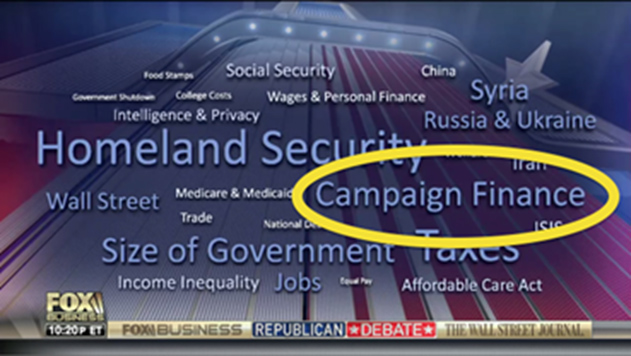
About an hour before the Fox Business/Wall Street Journal debate ended last night, the network showed a word cloud of issues viewers on Facebook were talking about and hoped to be brought up in the debate. The biggest issues: homeland security, taxes, the size of government, and campaign finance. Throughout the debate, the moderators asked and candidates promptly responded to questions regarding national and homeland security, the size of the federal government, and each candidates’ tax plan. The one top issue that was not brought up: campaign finance.
In a way, it’s not all that surprising that a money-in-politics question has not come up in the debates so far. The TV networks who have hosted the presidential debates – Fox News, CNN, MSNBC, CNBC, and Fox Business – are raking in huge sums of money in advertising dollars from political and issue ads. Just this week, Jeb Bush’s Super PAC anunciado it was buying $6.6 million in ad time on Fox News. The New York Times estimated that TV spending reached $2 mil millones in the 2014 midterm elections. It will likely be double that for this election season – if not more – with a national presidential election. That means big profits for TV networks and cable companies.
Cable and TV networks’ invested interest in profiting off our broken democracy explains why the National Cable and Telecommunications Association (a lobbying group for Comcast, Charter Communications, Disney, Cox Communications, Viacom, FOX Networks, and Time Warner Cable) and National Amusements (the parent of CBS & Viacom) both lobbied against the Ley de DIVULGACIÓN in Congress, a bill that would bring more transparency to political ads. The National Cable and Telecommunications Association has also lobbied against a proposed amendment to the U.S. Constitution to overturn Citizens United.
Just like we need to hold politicians accountable to voters, we need to hold media outlets accountable too. A recent New York Times poll shows that over 80% of the American public want to fundamentally change or completely overhaul the way political campaigns are funded. It’s time both the presidential candidates and news networks hosting future presidential debates – CBS, CNN, ABC, Fox News, NBC, Univision, and PBS – listen to the public.
Candidates and media outlets should be guided by the priorities laid out in the Agenda de lucha contra el gran dinero:
(1) Todos participan:proporcionar fondos públicos que amplificarán las pequeñas donaciones a candidatos federales que acepten reducir los límites de contribución.
(2) Se escucha la voz de todos: reducir las barreras de acceso a las urnas, aumentar la participación y establecer límites significativos a las contribuciones.
(3) Todo el mundo sabe quién intenta influir en nuestras opiniones y en nuestros representantes: exigir la divulgación del gasto político trabajando para aprobar leyes en el Congreso, impulsando la reglamentación de las agencias ejecutivas y emitiendo una orden ejecutiva sobre la divulgación del gasto político de los contratistas federales.
(4) Todos juegan según reglas justas y de sentido común: revocar Citizens United a través de una enmienda constitucional y cambiar el enfoque de la Corte Suprema sobre el dinero en la política con futuros nombramientos.
(5) Todos son responsables y se les imponen sanciones exigibles para disuadir el mal comportamiento: reformar la FEC para que los infractores de la ley rindan cuentas y cerrar los Super PAC de candidatos individuales.
Los periodistas deben preguntar, los moderadores del debate deben preguntar, los ciudadanos deben preguntar: ahora que todos estamos de acuerdo en que hay un problema, ¿qué van a hacer específicamente y qué tan pronto después de ser elegidos?