
Blog Post
What to Know About the 25th Amendment
You’ve probably been hearing talk about the 25th Amendment. Here’s what you need to know about it — and why Common Cause is calling for it to be used immediately.
Blog Post
2025 was a whiplash moment for American democracy.
We watched President Trump flood our cities with troops, cozy up to billionaires to enrich himself and his family, and attack our freedom to vote.
But Americans fought back and won in ways big and small—even if it didn’t make it in major headlines. Colorado and Maryland expanded voting access. Four states stopped Article V Convention efforts in its tracks. And Elon Musk, the man behind the infamous DOGE? Fired. See the full list of our victories here.
Now the midterms are looming, and the news cycle is about to become a partisan whirlwind. The real threats to democracy – the ones that will significantly impact your life – risk getting buried in chaos.
That’s why we compiled the top 5 democracy trends Common Cause is monitoring in 2026, and what we’re doing about them.
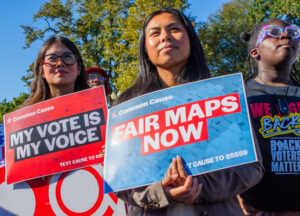
Background: In 2025, President Trump pressured Texas officials to redraw congressional maps and to deliver five more Republican seats to Congress. This action triggered an arms race among states to redraw maps for partisan advantage.
California, Missouri, North Carolina, and Texas have all adopted new mid-decade maps. This year, Virginia, Maryland, Florida are expected to weigh in.
What We’re Doing: Common Cause released the nation’s first set of fairness criteria – strong, consistent standards to evaluate mid-decade redistricting efforts and ensure people, not parties, come first.
In Virginia and Maryland, we’re warning lawmakers: follow the Fairness Criteria or face opposition. In Florida, we’re stating the obvious — mid-decade redistricting violates the state constitution.
We’re also pushing states to adopt independent redistricting commissions, and urging Congress to pass the Redistricting Reform Act of 2025, which would ban mid-decade redistricting and partisan gerrymandering nationwide.

Background: As of January 15, the DOJ has sued 23 states for refusing to turn over unredacted voter rolls. These rolls contain highly sensitive data including names, addresses, dates of birth, driver’s license numbers, and partial Social Security numbers.
The goal? Build an unauthorized national voter database. The risk? Mass voter purges, privacy violations, potential hacking, and federal overreach.
What We’re Doing: We’re leading a multi-state legal response to protect your data. We’ve filed lawsuits in 14 states challenging the DOJ’s illegal overreach, and we’ll keep fighting against efforts that could enable voter purges or data misuse.

Background: The world has entered the age of artificial intelligence (AI), in which false information powered by generative AI has the potential to poison our information ecosystems like never before. This leaves the public unable to know what images, audio, or video they can trust. Candidates, conspiracy theorists, foreign states, and online trolls all have cheap, powerful tools at their disposal to undermine our democratic discourse.
In a few clicks, using current AI technology, bad actors now have the power to spoof an entire county elections website and fill it with bad information, create false video of an elections official “caught on tape” saying that voting machines aren’t secure, or generate a robocall in the president’s voice telling millions of Americans their voting site has changed.
If left unaddressed, AI and information manipulation pose an existential threat to elections and democracy itself.
To make matters even worse, President Trump signed an executive order to make it easier to gut state AI laws. To be clear, the EO cannot override state AI laws, only Congress can do that. But the White House’s intention is clear: unencumbered technological innovation is the goal, even at the expense of our elections and civil and political rights.
What We’re Doing: Last year, Common Cause led the passage of an important update to the California AI Transparency Act, to help people tell the truth from fiction online. Now, we’re working with states nationwide to increase transparency, protect civil and political rights in digital spaces, combat AI-generated lies, and rebuild trust in the information we consume online.

Background: In 2025, President Trump sent troops to ten cities, including Washington D.C., Chicago, Los Angeles, and Portland, to intimidate and silence dissent. He has continued this intimidation tactic in 2026, deploying armed, federal ICE officers to Minnesota – overriding local officials and silencing residents who never asked for armed federal police patrolling their streets.
And of course, we are all still mourning the killing of Renee Good at the hands of ICE. Rather than unite us, Trump threatened to invoke the Insurrection Act against Minneapolis citizens protesting his federal overreach.
Voting experts warn deployments like these could intimidate voters and suppress turnout in the upcoming elections.
What We’re Doing: We’re calling for Congressional oversight of ICE and immigration enforcement. We demand that Congress not continue to fund ICE until there is accountability and reform. In Minnesota, Illinois, and California, we’ve worked with our partners to build rapid-response volunteer networks ready to protect their neighbors and strengthen community resilience. We’re also advocating for legislation like New York’s SB 8533, which would prevent other states from deploying their National Guard to New York without the governor’s consent.

Background: The Federal Election Commission (FEC) is the agency responsible for enforcing our campaign finance laws. But because it currently has four of its six seats vacant, the FEC can’t take any official actions or hold politicians accountable.
That means as we enter one of the most competitive elections in recent history, bad actors, foreign autocrats, and billionaires could be emboldened to game our elections and pour unlimited money into extremist candidates – without any oversight.
What We’re Doing: We’re calling on President Trump to fully staff the FEC with well-qualified commissioners so it can enforce campaign finance laws during the 2026 elections and make sure all candidates are playing by the same rules. We will also be educating the public about the five-year statute of limitations on campaign finance violations – to put candidates and donors on notice that their actions today could have consequences in the future.
Here’s the bottom line: democracy isn’t a spectator sport, and these troubling trends won’t fix themselves. But when people organize and fight back, we can make real change.
Share this post. And remember, your voice, your vote, and your attention matter more than ever before.
Want to join our people-powered movement? Follow Common Cause on X [Twitter], Instagram, LinkedIn, Threads, Facebook, and TikTok.
Blog Post
Blog Post
Blog Post